
Content marketing for small business is not about writing more. It is about answering the questions your customers already ask, in places they will find. This guide gives you seven plays that work for local companies, plus a 90-day plan.
The short answer: list the questions customers ask before they hire you. Answer each one on a clear page. Add proof like reviews and finished jobs. Turn the best pieces into short videos and emails. Keep it honest, and update what you publish.
Content marketing works alongside your website, your Google Business Profile and your email list. If you want us to handle it, see our content marketing services.

In this post
- What counts as content marketing?
- What Google says good content looks like
- Play 1: Answer the questions customers ask
- Play 2: Build strong service and local pages
- Play 3: Share real projects and proof
- Play 4: Make short videos from the same answers
- Play 5: Send the best pieces by email
- Play 6: Repurpose, do not repeat
- Play 7: Use AI carefully
- How to measure content marketing
- A 90-day content plan
- Which content should you make first?
- Topic ideas by type of business
- Content marketing for small business: common mistakes
- Next steps
What counts as content marketing?
Content is anything you publish that helps a possible customer decide. That includes:
- Service pages and FAQs
- Blog posts and guides
- Project photos and short case write-ups
- Short videos
- Emails
- Reviews you share with permission
- Social posts and Google Business Profile posts
Marketing means you plan it. You pick topics on purpose, publish them where buyers look and check what works.
What Google says good content looks like
You do not need a trick to get seen. Google’s guidance on creating helpful, reliable, people-first content is a good checklist.
Here is what it says in plain terms:
- Trust matters most. Google describes E-E-A-T, which stands for Experience, Expertise, Authoritativeness and Trust, and says trust is the most important part.
- Show real experience. Google asks whether content offers original information, research or analysis, and whether you would bookmark, share or recommend it.
- Say who wrote it. Google asks for clear authorship, such as a byline that links to the author’s background.
- Say how it was made. If automation or AI was involved, explain how, where readers would reasonably want to know.
- Write for people first. Google warns against content made mainly to attract search traffic, against summarizing others’ work without adding value, and against changing dates to look fresh when the content has not changed in a real way.
That last point matters for any update. If you refresh an old page, change what is on it. Do not only change the date.
Play 1: Answer the questions customers ask
This is the best starting place. Real questions beat guessed keywords.
- Collect questions. Check calls, texts, quote forms, review replies and your own email.
- Group them. Put them under your services, such as price, timing, steps and problems.
- Write one clear answer for each. Start with the answer, then explain.
- Put the answer where people will see it. Use the service page, an FAQ or a blog post.
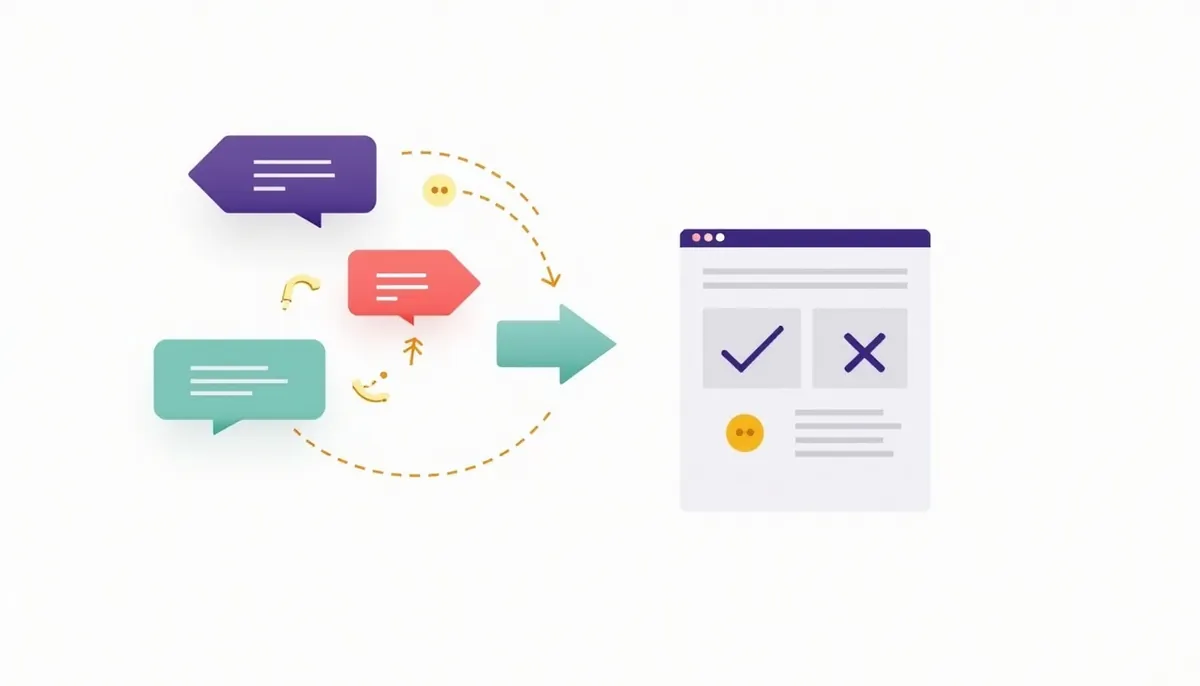
Here is a sample for an HVAC company. It is an example of the method, not data.
| Customer question | Where to answer it |
|---|---|
| How do I know if my furnace needs repair or replacement? | Blog post with a simple decision guide |
| Do you offer same-day service? | FAQ on the service page |
| What happens during a tune-up? | Short checklist page and a video |
Our guide to writing website content shows how to structure each answer. Our post on local keyword research shows how to check the words people type.
Play 2: Build strong service and local pages
Before you start a blog, make sure your main pages are in shape. A service page should say what you do, who it is for, where you work, what the steps are and how to reach you.
Check each service page for:
- One clear headline that names the service and the area
- A short plain description of the work
- Real photos of your own jobs
- Reviews or short quotes, with permission
- A short FAQ
- A phone number and form that are easy to use on a phone
Our template for on-page SEO for service pages and our guide to website photos without stock go deeper.
Play 3: Share real projects and proof
People want to see that you do what you say. Share finished projects in a short write-up:
- What the customer needed
- What you did
- What the customer said, if they agreed to be quoted
- A few real photos
Do not invent clients or results. If you do not have permission to name someone, describe the job without names. Never post a number you cannot back up.
Reviews are content too. Ask happy customers for a Google review, then share the best ones with their OK. Our guide to getting more Google reviews covers how to ask the right way.
Play 4: Make short videos from the same answers
You already know the answers. Say them on camera. A short clip can show a tune-up, a before-and-after or a quick tip. You do not need a studio. A steady phone and good light work well.
Keep these rules:
- One idea per video.
- Say who you are and where you work in the first few seconds.
- Add captions, since many people watch without sound.
- Post it on your service page and on social media.
Our post on video marketing ideas shows seven things to film.
Play 5: Send the best pieces by email
Your site gets visitors who are not ready today. Email lets you stay in touch. Share one useful piece every two weeks or each month. Link to the page that answers the question.
If you do not have a list yet, start with our guide to email marketing for small business. To get more from a list you already have, read our email marketing tips.
Play 6: Repurpose, do not repeat
One good answer can become many small pieces. Do the work once, then use it in several ways.

A single article can become:
- A short video of you giving the main tip.
- An email with the top three points and a link.
- A social post with one photo and a short caption.
- A printable checklist for the page.
This is not copy-and-paste. Change the format for the place. A short post and a long guide need different writing.
Play 7: Use AI carefully
AI can speed up a first draft, an outline or a list of questions. It cannot replace your experience.
Google’s guidance on using generative AI content says that using these tools to generate many pages without adding value for users may violate its spam policy. It also says generative models predict a likely sequence of words rather than retrieve facts, and that it is critical to fact-check and review all AI-generated content. The review applies to titles, meta descriptions and image alt text, too.
A safe way to use AI:
- Use it for outlines, rewording and summaries of your own notes.
- Add your own facts, photos and local detail.
- Check every claim against a real source.
- Never use it to invent reviews, clients or results.
Our AI marketing automation guide covers where AI helps in marketing more broadly.
How to measure content marketing
Do not count only visits. Track what helps the business:
- Calls and forms that start on a content page.
- Searches that find you. Google Search Console is a free service from Google. It shows which search queries bring up your site and how often people click through.
- Replies and questions. Do customers mention a page?
- Reviews and referrals. Ask new customers what they read or watched.
Look once a month. Keep a short log: what you published, what changed and what you will try next.
A 90-day content plan

A simple 90-day plan
- 1Days 1 to 14. List 20 customer questions. Check your top three service pages against the list in Play 2.
- 2Days 15 to 30. Answer the five most common questions on your service pages or in an FAQ. Add real photos.
- 3Days 31 to 60. Publish two longer guides that answer big questions. Film three short videos from the same answers.
- 4Days 61 to 90. Send two emails with your best pieces. Refresh one older page with real changes. Review calls, forms and searches. Pick next quarter’s topics.
If you already have lots of old pages, start with a content inventory. Our guide to building a content inventory shows how to sort pages into keep, update and remove.
Which content should you make first?
Use this table to choose where to start. It is a guide based on how buyers decide, not a rule.
| Your situation | Start with | Why |
|---|---|---|
| Thin or outdated service pages | Play 2: fix service pages | Buyers land here first |
| Few reviews or photos | Play 3: proof | Trust is the gap |
| Same questions on every call | Play 1: answer them | Saves time and pre-sells |
| Good content but nobody sees it | Play 5: email and Play 6: repurpose | You need more reach |
| You publish a lot but get no calls | Check calls to action and phone use | The gap may be on the page, not in the topic |
Topic ideas by type of business
These are starting points to adapt. Check each against your own customer questions.
- Paving and exterior: How to prepare for a new driveway. What a repair looks like compared with a replacement. What to ask before you sign.
- HVAC and plumbing: Signs a system needs service. What a tune-up includes. What to do before the technician arrives.
- Dental and medical offices: What to expect at a first visit. How to prepare for a procedure. Common questions about insurance paperwork.
- Accounting and legal: A checklist of papers to gather. A plain-English explainer on a common process. When to call a professional.
- Landscaping: A month-by-month calendar. How to pick plants for local weather. What a maintenance visit covers.
Notice what each has in common. The title names a real problem and promises a clear answer.
Content marketing for small business: common mistakes
- Publishing often but saying little.
- Writing for search engines instead of customers.
- Using stock photos instead of real work.
- Not saying who wrote the page.
- Changing only the date on an old post.
- Skipping the call to action.
- Posting once, then going silent for months.
- Making big claims you cannot back up.
Frequently asked questions
What is content marketing in simple terms?
It is publishing helpful information so buyers find you and trust you before they call. It includes pages, posts, videos, emails and reviews.
How often should I publish?
Pick a pace you can keep. One strong page or post a month beats four weak ones. Quality and steadiness matter more than volume.
Do I need a blog?
Not always. Start with strong service pages and an FAQ. Add a blog when you have real questions to answer.
How long does content marketing take to work?
It depends on your market, your site and your effort. No one can promise a timeline. Track calls and forms from the start.
Can I use AI to write my content?
You can use it as a helper. Google says to fact-check and review all AI-generated content, and warns against producing many pages without adding value. Add your own experience and sources.
Should I update old posts?
Yes, if you add real value. Update facts, fix broken links and add new examples. Do not only change the date.
Next steps
Start with Play 1 this week. Write down 20 questions your customers ask, then answer the top five on your site.
Want help turning those questions into pages, videos and emails? Learn more about our content marketing services and digital marketing services. You can also run our free website teardown to see what your site is missing.
Want help with this in Carlisle or Central PA?
Webfactory Media is a Carlisle, PA agency. See our content marketing in Carlisle and content marketing services pages, or call (888) 849-2397 and we will look at your site for free.