Last reviewed November 2026.
Short answer
SEO usually takes several months to show clear results, and no honest provider can name an exact date. Google says some changes take a few hours while others take several months. In our experience, expect early signs in weeks, steady movement in three to six months, and stronger results over six to twelve months. These are our estimates, not Google figures, and they depend on your market, your site and the work done.
You want to know when SEO will pay off. This guide gives a straight answer, explains why it takes time, and shows what to expect in each stage. You also get checklists to tell whether it is working.
This guide is part of our local SEO guide for small business.
- Why SEO takes time
- What Google and the data say
- What happens month by month
- What speeds it up or slows it down
- How long for Central PA businesses
- How to tell if SEO is working
- A made-up example with the math
- Common mistakes
- What to do today
- Frequently asked questions
Why SEO takes time
SEO means search engine optimization. It is the work of making your site and your business easy for Google to find, understand and trust. The goal is to appear when people search for what you sell.
Three steps happen before anyone sees your page in results. Each one takes time.
- Crawling. Google sends automated programs, called crawlers, to visit pages. Google says it finds pages mainly through links from other pages it already crawled.
- Indexing. Google tries to understand the page and stores it. Not every page makes it in.
- Ranking. Google decides where your page appears for a search. Your competitors are working on their pages too.
Crawling and indexing are about getting seen. Ranking is about being chosen. The first two can take days or weeks. The third can take months, because you are being compared with every other page that fits the search.
Trust is the slow part. A new business with few reviews, few mentions and a thin site has little to show Google. That history builds with time, work and real customers.
What Google and the data say
What Google says
Google is plain about timing. In its SEO starter guide, it says: “Some changes might take effect in a few hours, others could take several months.” It also says: “In general, you likely want to wait a few weeks to assess whether your work had beneficial effects in Google Search results.”
On crawling, Google’s recrawl page says: “Crawling can take anywhere from a few days to a few weeks.” It adds that asking for a recrawl more than once for the same page will not get it crawled any faster.
On promises, Google’s guidance on hiring an SEO is blunt: “No one can guarantee a #1 ranking on Google.” It suggests asking any provider: “What kind of results do you expect to see, and in what timeframe?”
What the data says
The Ahrefs study looked at how often new pages reach the top ten results. It took 1 million random pages that its crawler saw in September 2023. Only 1.74% of them reached the top ten within a year. In a second sample of 2 million random English pages created in October 2023, 6.11% did.
Two lessons come from this. First, most new pages do not reach the top ten in a year. In our view, a page that has not ranked yet is not a failure. Second, Ahrefs also found that 40.82% of the pages that did reach the top ten got there within one month. Ranking is not always slow, but it is uneven.
This study covers all kinds of searches, not just local ones. Use it as a reminder of how uncertain ranking is, not as a forecast for your site.
What many agency guides miss
Many guides say three to six months, and some say six to twelve. When we checked a few popular ones, none showed data behind those ranges. Some also give a neat month-by-month plan that treats every site the same. Your timeline depends on your site, your town and your competitors. The ranges in this guide are our own experience-based estimates, not data. Treat any fixed schedule as a rough guide.
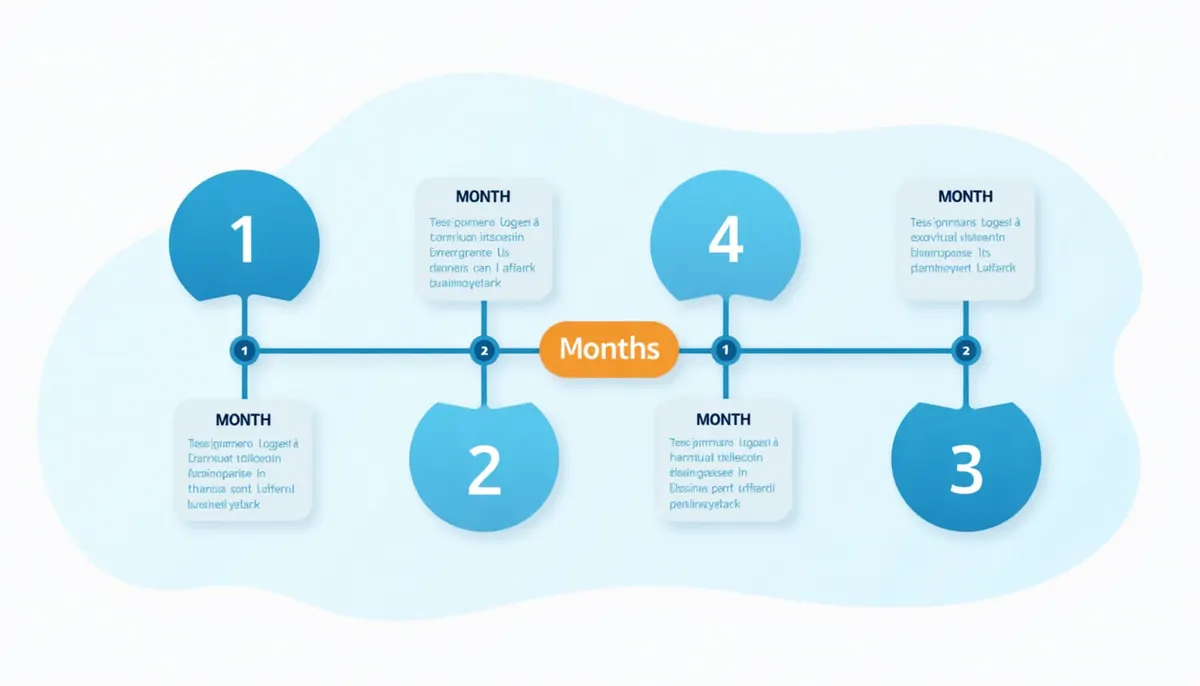
What happens month by month
These are our experience-based patterns, not promises or Google figures. Your site may move faster or slower. The point is to know what kind of progress to look for in each stage.
Month 1: fix and set up
The first month is mostly groundwork. Little changes in results, and that is normal.
- Set up Search Console and analytics so you can measure from day one.
- Check that your key pages can be found and are indexed.
- Fix your Google Business Profile: categories, services, hours, phone number and photos. Our Google Business Profile checklist lists each item.
- Find and fix technical problems, such as slow pages or broken links.
- Pick the searches that matter most, using local keyword research.
What you may see: your first impressions in Search Console, and small changes in your profile. What you should not expect: a jump in calls.
Months 2 and 3: build the pages
Now the real pages go up. Each service gets its own page, written for the questions customers ask. Pages are linked to each other and to the right places on your site.
- Write or improve one page per main service, using a template like this on-page SEO template.
- Add service area pages if you work in several towns. See SEO for service area businesses.
- Start a steady routine to ask happy customers for reviews. See how to get more Google reviews.
- Clean up your listings so your name, address and phone match everywhere. See local citations and NAP.
What you may see: pages getting indexed, impressions rising, and your pages showing up on page two or three for some searches. Google suggests waiting a few weeks after a change before judging it, so give new pages time.
Months 4 to 6: results start to show
Some local sites may begin to see a trend here, especially if the market is not very crowded. Pages that were indexed in months two and three have had time to settle. Reviews have piled up.
- Impressions and clicks rise in Search Console for the searches you targeted.
- Your profile gets more calls, direction requests and website clicks.
- Some pages move onto page one for lower-competition searches.
- You see which pages work and which do not, and you improve them.
What you may see: a few leads each month that you can trace to search. What you should not expect: first place for the biggest searches in your trade.
Months 6 to 12: compounding
SEO works like a savings account. Each page, review and mention adds to what is already there. After six months, you have enough history to see what is working.
- Improve pages that sit just below page one.
- Add pages for questions you saw in your own calls and emails.
- Earn more local mentions and links. See link building for local businesses.
- Keep asking for reviews and keep your profile fresh.
What you may see: steadier leads and less swing from month to month. Competitive searches may still take longer, and some may stay out of reach. That is a business decision, not a failure: you can focus on searches you can win.
The timeline at a glance
| Stage | Main work | Early signs to look for | What not to expect |
|---|---|---|---|
| Month 1 | Setup, profile fixes, tracking, technical fixes | First impressions in Search Console | More calls |
| Months 2-3 | New and improved service pages, reviews, listings | Pages indexed, impressions rising | Page one for hard searches |
| Months 4-6 | Refine pages, more reviews, more local mentions | Clicks and profile actions rising, some page-one results | First place on the biggest searches |
| Months 6-12 | Expand, update, earn mentions | Steadier leads, clearer picture of what works | A guaranteed outcome |
What speeds it up or slows it down
Two businesses can do the same work and see different timelines. These are the main reasons.

| Factor | Faster when | Slower when | What you can do |
|---|---|---|---|
| Competition | Few firms in your town compete for the search | Many strong, established firms | Target narrower searches, such as a service plus a town |
| Site history | Site is healthy, with a clean record | New site, thin pages, or past problems | Fix the basics before adding more |
| Technical health | Pages load fast and can be crawled | Slow pages, broken links, blocked pages | See how to speed up WordPress |
| Content | One clear page per service, written for customers | One page tries to cover many services | Give each service its own page |
| Reviews and profile | Complete profile, steady fresh reviews | Few reviews, wrong categories | Ask every happy customer, every job |
| Search type | Narrow, local, specific search | Broad, national, high-demand search | Pick searches you can win first |
| Speed of work | Approvals and changes ship in days | Changes wait weeks for sign-off | Name one person who approves quickly |
Money alone does not fix any of these. A bigger budget can get more done, but Google says there is no way to pay for a better local ranking. The work still has to be crawled, understood and compared with others.
How long for Central PA businesses
If you serve Carlisle, Mechanicsburg, Harrisburg, Camp Hill or Shippensburg, your timeline depends on how many local firms target the same search. A crowded trade in a bigger town can be harder than a niche trade in a small borough. Your trade and your town matter more than any average.
Local results are different from normal results. Google Business Profile Help says local results are mainly based on relevance, distance and popularity. Distance matters: a customer searching from Camp Hill may see different businesses than one in Carlisle. You cannot change where your customers stand, but you can make sure your profile and pages fit the towns you serve.
- Check from the right spot. Search from your service area, not only from your office.
- Build for each town. A real page for each main town you serve beats one page that lists them all.
- Use real local details. Name the roads, neighborhoods and job types you know. Do not copy a page and swap the town name.
- Earn local mentions. Chambers, suppliers, local events and partners can be a better sign than random directories.
For the map side, read how to rank in Google Maps. For the full plan, see Local SEO for Small Business.
How to tell if SEO is working
Rankings are only one piece of the picture, and they move around. Use a short list of numbers and check them once a month. Write down the date of each change so you can compare later.
Three numbers to track
- Impressions and clicks. Search Console defines impressions as how many times your site appeared in search results, and clicks as how many times a user clicked your site from Google Search results. The newest data can be preliminary, so wait a few days before judging it.
- Profile actions. In your Google Business Profile, look at calls, direction requests and website clicks.
- Leads. Count calls and form fills, and ask each new customer how they found you.
You can read the full definitions in Search Console Help.
A monthly pass or fail check
| Check | Pass | Fail, so ask why |
|---|---|---|
| Key pages indexed | Search Console shows the page is indexed | Page is not indexed after a few weeks |
| Impressions | Trending up over three months | Flat or falling after real changes |
| Profile actions | More calls and direction requests | No change, or a profile with old details |
| Reviews | New reviews each month, with replies | Few new reviews |
| Work log | Provider shows what was done this month | Vague reports with no list of work |
| Leads | More calls or forms from search over time | No traceable leads after six months of real work |
Test whether Google has your page
- Open Search Console and paste the full page address into the search bar at the top.
- Read the result. It says whether the page is indexed and when Google last crawled it.
- If the page is not indexed, check that it is linked from other pages on your site and that nothing blocks it.
- Use the request indexing button once. Google says repeated requests for the same page do not speed it up, and a request does not guarantee the page will be added.
- Check back in a few days. Write down the date.
Want help putting this into practice? We handle local SEO for small businesses in Central PA. See our SEO services for small businesses, or if you are in Central PA, our SEO in Carlisle, PA page.
A made-up example with the math
This example uses invented round numbers to show how early progress can look. It is not a real client and not a forecast.
| Month | Impressions | Clicks | Calls | Math |
|---|---|---|---|---|
| 1 | 100 | 2 | 0 | Setup month. Few pages are indexed yet. |
| 3 | 800 | 24 | 1 | If 3 in 100 impressions become clicks: 800 × 0.03 = 24 |
| 6 | 2,500 | 100 | 4 | If 4 in 100 become clicks: 2,500 × 0.04 = 100 |
| 9 | 4,000 | 200 | 8 | If 5 in 100 become clicks: 4,000 × 0.05 = 200 |
In this story, impressions rise first, clicks follow, and calls come last. Calls here are made-up, at 4 in 100 clicks. At month 3 the business sees almost no calls, but the trend is already up. A business that quit at month 3 would never see month 9. A business that never looked at the numbers could not tell the difference.
Real numbers will differ. Some sites rise faster, some stall, and some fall after a Google update. The lesson is to watch the trend and compare it with your own starting point.
Common mistakes
- Quitting at month three. Some sites are still building at that point. Judge the trend, not one month.
- Checking rankings every day. Results move around by device, place and time. Check monthly.
- Changing everything at once. You cannot tell what worked. Change a few things and note the dates.
- Asking for the same page to be indexed over and over. Google says it does not help.
- Believing a guarantee. No one can guarantee a #1 ranking. A provider who does is a warning sign.
- Targeting only the biggest search. Start with narrower searches, such as a service plus a town.
- Ignoring the phone. Rankings do not help if calls go unanswered. Reply the same day.
- Skipping reviews. Google says more reviews and positive ratings can help your local ranking.
- Buying cheap links. Paid links meant to pass ranking credit fall under link spam in Google’s spam policies and can set you back.
What to do today
You do not have to wait with your hands empty. These steps take less than a day and help no matter when results arrive.
- Open Search Console and confirm your site is verified. If it is not, set it up.
- Write down your starting numbers: impressions, clicks, profile calls and leads this month.
- Search your main service plus your town. Note which pages appear, and who is above you.
- Fix one thing in your Google Business Profile, such as the primary category or the service list.
- Ask your three most recent happy customers for a Google review.
- List the questions customers ask you most. Each one is a possible page or section.
Want a quick outside read? Our free marketing review shows what holds a site back, in plain language. You can ask for it on our contact page. If you are weighing SEO against paid ads, see SEO vs Google Ads and Google Ads vs SEO for a local business.
Questions to ask a provider about timing
- What will you do in month one, and what comes after?
- When should I see movement in impressions, and when in calls?
- What could slow things down on my site or in my market?
- How will you report, and how often? Can I see a list of work done?
- What happens if the numbers do not move by month six?
Google suggests asking what results a provider expects and in what timeframe. A good answer is specific about the work and honest about the uncertainty. For more, read How to Choose an SEO Company and How Much Does SEO Cost.
Frequently asked questions
How long does SEO take to work?
SEO usually takes several months to show clear results, and no one can name an exact date. Google says some changes take a few hours and others several months. Small fixes show up first. Rankings for competitive searches take longest. Judge progress by the trend over months, not by one week.
How long does it take Google to index a new page?
Google says crawling can take anywhere from a few days to a few weeks. Some pages are picked up faster, and some are never indexed. Asking again for the same page does not speed it up. Make sure the page is linked from other pages on your site, then check its status in Search Console.
Can SEO work in 30 days?
SEO can show early signs in 30 days, but rarely a clear lead increase. In the first month, work is mostly fixes and setup. You may see more impressions in Search Console or changes in your Google Business Profile. Expect proof of lasting gains later, and treat any promise of page one in a month with doubt.
Why is my SEO not working after 3 months?
Three months is often too soon to judge, but check the basics. Ask whether your pages are indexed, whether they match what customers type, and whether the work was done on schedule. Then look at impressions. If they are flat after real changes, the plan needs review, not more waiting.
Is local SEO faster than regular SEO?
Local SEO can move faster for some searches, but it is not guaranteed. Google says local results rely mainly on relevance, distance and popularity. A complete profile and fresh reviews may help your map results, but we cannot say they work faster. Competition in your town still sets the pace.
Does paying more make SEO faster?
More money can mean more work done in the same time, but it does not buy a ranking. Google says there is no way to pay for a better local ranking, and that no one can guarantee a number one spot. Extra budget helps most with content, fixes and reviews. It cannot shorten how long Google takes.
Should I use ads while I wait for SEO?
Ads can bring calls while SEO builds, because they start when you launch the campaign. They stop when you stop paying. SEO takes more time up front, and its results do not stop the day a campaign budget ends. Some local businesses run both. Our guide on SEO versus Google Ads explains how to choose.
How do I know SEO is working without waiting for rankings?
Check three things monthly. Look for more impressions in Search Console, more profile actions such as calls and direction requests, and more form fills or calls from search. If all three trend up over a few months, the work is moving. If none do, ask your provider to show what was done.
Ask for your free marketing review
Webfactory Media is a digital marketing agency in Carlisle, PA. Our free marketing review looks at where your site stands. We do not promise rankings. See our SEO services. You can also call (888) 849-2397.
Related guides
- Local SEO for Small Business: A Plain Guide
- How Much Does SEO Cost for a Small Business?
- How to Rank in Google Maps: What Moves the Local Pack
- SEO vs Google Ads: Which Should a Local Business Pay For First?
- SEO services for small businesses
Want help with your SEO?
Webfactory Media is a digital marketing agency in Carlisle, PA. See our SEO services, ask for a free marketing review, or call (888) 849-2397.